Reset Guides · Gut Health · Free · 12 min read
Last reviewed 10 October 2026
The Gut Reset
A free, practical guide to everyday gut health — how your microbiome works, what quietly disrupts it, and six daily habits that restore comfortable, steady digestion.

TL;DR
- Your gut microbiome is a community of trillions of microbes that helps digest fibre, train the immune system and talk to the brain.
- Eating a wider variety of plants is the single most useful change you can make — not because a varied gut is the goal in itself, but because different plants feed different microbes, including the ones that make butyrate.
- Butyrate is the one to care about. Microbes make it when they ferment fibre, and it is the main fuel for the cells lining your colon.
- Everyday disruptors include ultra-processed food, low fibre, chronic stress, irregular sleep and grazing all day.
- The reset: aim for 30 different plants a week, add a daily fermented food, raise fibre slowly, leave gaps between meals, and anchor sleep and stress rhythms.
01What your gut microbiome is
Your large intestine is home to tens of trillions of bacteria, along with fungi, viruses and archaea. Together they carry far more genes than your own cells, and many of those genes do jobs your body cannot do alone — most importantly, breaking down the plant fibres that human enzymes leave untouched.
No two microbiomes are identical. Yours was seeded at birth, shaped by early feeding, and has been edited ever since by what you eat, where you live, how you sleep and the medicines you take. The good news is that it is responsive: measurable shifts in microbial composition can appear within days of a change in diet.
Researchers have not found a single "ideal" microbiome. What healthier guts tend to share is variety — many different species doing overlapping jobs — and resilience, the ability to bounce back after a disruption such as a stomach bug, a stressful month or a holiday of unfamiliar food.
02What it does for you every day
Digestion and nutrients. When fibre reaches the colon intact, microbes ferment it into short-chain fatty acids: acetate, propionate and butyrate. Butyrate is the preferred fuel of colon cells and helps maintain the tight junctions that keep the gut lining sealed. Gut microbes also help produce vitamin K and some B vitamins.
Immune calibration. Your gut wall holds more antibody-making cells than your spleen, lymph nodes and bone marrow put together. A varied microbiome helps the immune system learn the difference between harmless food, friendly microbes and genuine threats — one reason gut health is linked to how the body handles inflammation.
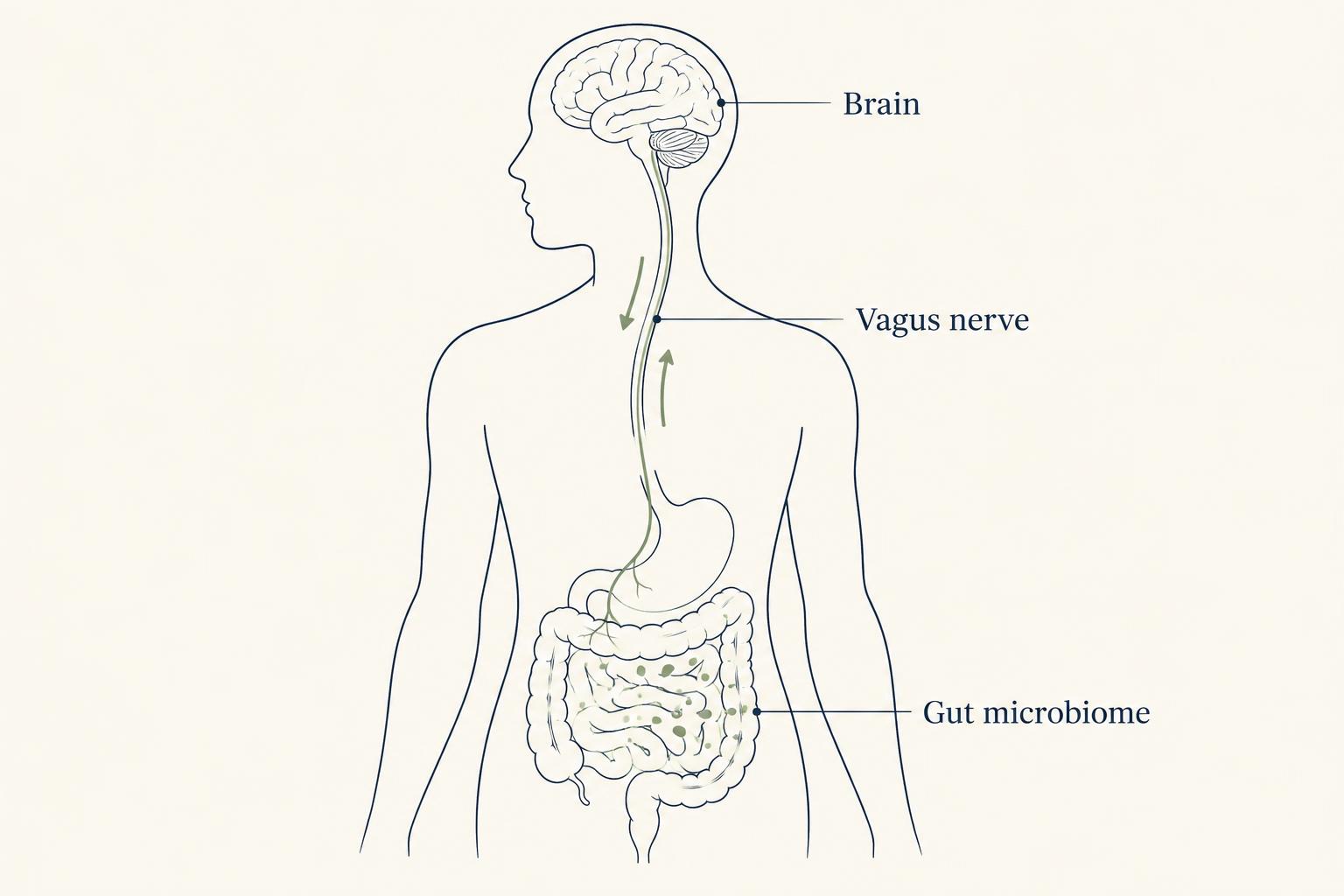
The gut–brain axis. The gut and brain are wired together through the vagus nerve, hormones and immune signals. Roughly 90% of the body's serotonin is made in the gut, though it stays there: it regulates gut movement rather than travelling to the brain. The real link runs the other way round — through microbial by-products, immune signals and the raw materials your gut makes available. This is why anxiety can upset digestion, and why a troubled gut can drag on mood and focus.
Metabolic steadiness. Fibre fermentation and microbial signals influence appetite hormones and how sharply blood sugar rises after meals. A fibre-rich, varied diet tends to produce steadier energy through the day.
03What quietly disrupts it
"Dysbiosis" describes a microbiome that has lost variety or shifted towards species that thrive on a low-fibre, high-sugar environment. It is rarely caused by one dramatic event. More often it is the slow result of ordinary modern habits.
| What disrupts it | What it does | What helps |
|---|---|---|
| Ultra-processed food | Mostly a fibre problem. One two-week trial also found a common emulsifier altered gut bacteria, in some people more than others | Keep it to the edges of the week rather than the middle of every day |
| Low fibre | Most UK adults eat around 20g a day against a recommended 30g. Starved microbes make less butyrate, and in animal studies some switch to feeding on the protective mucus layer | Raise fibre gradually to 30g — see step 3 |
| Chronic stress | Stress hormones alter gut movement, mucus production and permeability, and can shift microbial balance within weeks | One daily wind-down beats an occasional big effort |
| Irregular sleep and meal timing | Gut microbes follow daily rhythms. Late nights, shift work and eating at random hours blur them | A consistent wake time matters more than a consistent bedtime |
| Medicines | Regular acid-suppressing drugs and some others shift the microbiome | Never stop a prescribed medicine on your own — raise it with your GP |
Antibiotics are the best-known disruptor, and they are a topic of their own. How much they change things depends far more on which antibiotic you took than on the fact of having taken a course. If you have recently finished one, read our Complete Guide to Antibiotics and Gut Health for what recovery looks like.
04The five signs people look for
- Digestive: regular bloating, wind, irregular or uncomfortable bowel movements, or reflux after meals.
- Energy: a heavy, sluggish feeling after eating, or energy that crashes mid-afternoon.
- Mood and focus: low mood, irritability or brain fog that seems to track with digestive flare-ups.
- Skin: flare-ups of conditions such as eczema or acne that worsen alongside digestive symptoms.
- Immunity: picking up every passing cold or taking a long time to recover.
05The six-step Gut Reset
1. Aim for 30 plants a week
The American Gut Project — a large study of people's everyday diets — found that those eating 30 or more different plant foods a week had more varied microbiomes than those eating 10 or fewer. It compared people rather than testing a change, so 30 is a useful target rather than a magic number. The direction is what counts: more different plants, not more of the same ones. Vegetables, fruit, wholegrains, beans, lentils, nuts, seeds, herbs and spices all count, and a mixed bag of seeds or a tin of three-bean mix can add several in one go.

| Category | Aim for about | Easy wins |
|---|---|---|
| Vegetables | 8–10 | Frozen mixed veg, a bag of salad, whatever is cheap that week |
| Fruit and berries | 5–6 | Frozen berries, a banana, apples, tinned pears in juice |
| Wholegrains | 3–4 | Oats, brown rice, wholemeal bread, barley in a soup |
| Beans, peas and lentils | 3–4 | Tinned mixed beans, red lentils, frozen peas, hummus |
| Nuts and seeds | 3–4 | A mixed bag of nuts, a mixed bag of seeds |
| Herbs and spices | 5–6 | Dried oregano, cinnamon, cumin, garlic, fresh parsley |
Different varieties count separately — red and white onions, or green and brown lentils, are two each. Herbs and spices count, which is the easiest way to add five without changing a meal.
2. Add one fermented food a day
A Stanford trial found that ten weeks of fermented foods — yoghurt, kefir, kimchi, sauerkraut, kombucha — increased microbial variety and lowered markers of inflammation in the blood. A larger trial since has been less clear-cut, which is why this sits as one habit among six rather than the centrepiece of the reset. Start with a few tablespoons and build up, and choose unpasteurised, refrigerated versions where you can; many shelf-stable products no longer contain live cultures.
3. Raise fibre slowly
Jumping from 15g to 35g of fibre overnight is a recipe for wind and cramps. Add roughly 5g a week, drink more water as you go, and stop climbing once you reach 30g — that is the recommendation, not a floor to beat. Prebiotic-rich foods are worth building in as you go: onions, leeks, garlic, asparagus, slightly green bananas, and cooked-then-cooled potatoes or rice.
| Week | Daily fibre | One change that gets you there |
|---|---|---|
| Starting point | About 20g, the UK average | — |
| Week 1 | 25g | Swap white bread and rice for wholegrain versions |
| Week 2 | 30g | Add a handful of lentils or beans to one meal a day |
| Week 3 | 30g, steady | Hold here. Add variety rather than quantity |
| Week 4 | 30g, steady | Rotate different plants in week to week |
4. Leave gaps between meals
Between meals, the small intestine runs a cleaning wave called the migrating motor complex, which sweeps leftover food and bacteria onward. It only runs when you are not eating, which is a good argument against grazing from breakfast to bedtime.
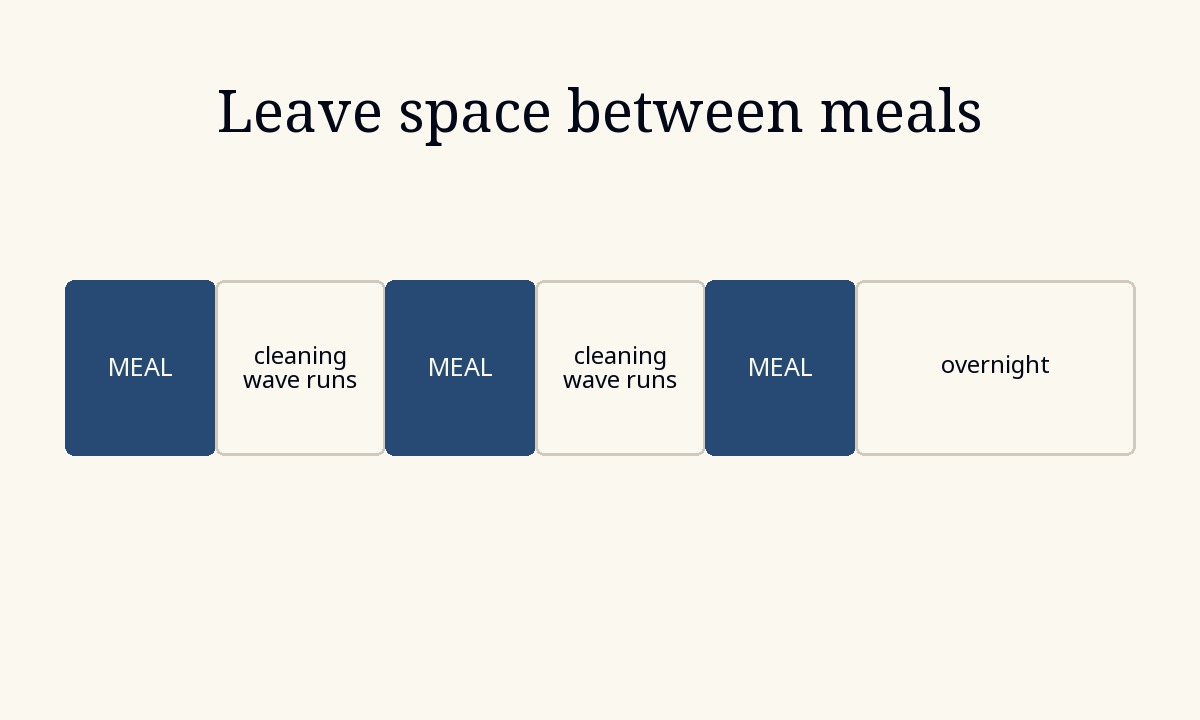
Three to four hours between meals, and a longer gap overnight, is a sensible way to give it room. Those particular numbers are a rule of thumb rather than a tested prescription — no trial has compared them — but the underlying point is sound, and people often find the bloating eases on its own.
5. Ease off the main irritants
You do not need an elimination diet. Simply reduce the things most likely to irritate: heavy alcohol, very large late meals, fizzy drinks if they bloat you, and ultra-processed snacks. Eating more slowly and chewing well reduces swallowed air and gives digestive enzymes a head start.
6. Anchor sleep and stress rhythms
Keep wake time consistent, get daylight in the morning, and build in one daily wind-down — a walk after dinner, ten minutes of slow breathing, or a screen-free half hour. These calm the gut–brain axis and support the daily rhythms your microbes follow.
06What a gut-friendly week looks like
Nothing here needs a special product. Breakfast might be overnight oats with kefir, mixed seeds and berries. Lunch could be a lentil and roasted vegetable salad with herbs and olive oil. Dinner might be a stir-fry with tofu, three or four vegetables, brown rice and a spoon of kimchi. Across a week, that pattern passes 30 plants comfortably.
| Day | Breakfast | Lunch | Dinner |
|---|---|---|---|
| Monday | Overnight oats, kefir, berries, seeds | Lentil and roast vegetable salad | Stir-fry with tofu, brown rice, kimchi |
| Tuesday | Wholemeal toast, nut butter, banana | Leftover stir-fry with added greens | Bean chilli, barley, coriander |
| Wednesday | Yoghurt, mixed nuts, pear | Hummus and salad wholemeal wrap | Baked fish, new potatoes, three veg |
| Thursday | Porridge, cinnamon, frozen berries | Leftover chilli on a jacket potato | Chickpea curry, wholegrain rice |
| Friday | Kefir smoothie, spinach, oats | Mixed bean soup, wholemeal roll | Whatever you fancy — one night off |
| Saturday | Eggs, mushrooms, wholemeal toast | Big mixed salad, seeds, feta | Roast with four different vegetables |
| Sunday | Yoghurt, granola, apple | Leftover roast, grain salad | Minestrone with pasta and beans |
Snacks across the week: an apple and a handful of nuts, hummus and carrot, a few squares of dark chocolate.
On timings. Comfort tends to change first — some people notice less bloating and more regular digestion within one to two weeks, and others notice nothing for a month.
07Track it for four weeks
Two things are worth writing down, because both are easy to overestimate from memory. Fill the plant tracker in as you go rather than at the end of the week — the point is to spot the gap in a category while there is still time to fix it.
Your 30 plants this week
| Category | Target | What you ate | Count |
|---|---|---|---|
| Vegetables | 8–10 | ||
| Fruit and berries | 5–6 | ||
| Wholegrains | 3–4 | ||
| Beans, peas and lentils | 3–4 | ||
| Nuts and seeds | 3–4 | ||
| Herbs and spices | 5–6 | ||
| Total | aim for 30 |
The six habits
| Habit | M | T | W | T | F | S | S |
|---|---|---|---|---|---|---|---|
| Hit my plant count for the day | |||||||
| One fermented food | |||||||
| Fibre at this week's level | |||||||
| Gaps between meals | |||||||
| Eased off the irritants | |||||||
| Consistent wake time and a wind-down |
Four or five ticks a row across a week is a good week. Seven out of seven on every row is not the goal, and chasing it is how people give up in week three.
08When to speak to your GP
None of these is something to manage with diet while you wait and see, and none of them means something is seriously wrong — they are simply the symptoms that need ruling out rather than reasoning about. If your symptoms persist despite good habits, ask about testing for coeliac disease and a referral for a low-FODMAP plan with a dietitian.
Frequently Asked Questions
- Do I need to take probiotic supplements?
- Not necessarily. For most people, a varied, fibre-rich diet with daily fermented foods does more for microbial variety than a capsule. Specific strains can help specific conditions, so discuss them with a clinician if you are considering one.
- Are microbiome tests worth paying for?
- Not yet, for most people. The tests are real enough at identifying what is in a sample, but there is no agreed definition of a healthy result to compare yours against, and the dietary advice that comes with them is usually the same advice in this guide. Spend the money on food instead.
- How long before I notice a difference?
- Some people notice more comfortable digestion within one to two weeks; others notice nothing for a month, and that is not a sign it isn't working. Changes in the microbiome itself take longer — the trials that measured them ran for eight to ten weeks — and they are not something you will feel directly.
- Is The Gut Reset suitable if I have IBS?
- The general principles are safe, but some high-fibre and fermented foods can trigger IBS symptoms. Raise fibre slowly and consider working with a dietitian on a structured low-FODMAP approach.
- What if I've just finished antibiotics?
- This guide focuses on everyday gut health. For what antibiotics do to the microbiome and how recovery works, read our Complete Guide to Antibiotics and Gut Health.
- How is this different from The Bloating Reset?
- The Gut Reset builds long-term microbiome health and digestive balance. The Bloating Reset focuses specifically on identifying and easing day-to-day bloating triggers.
Educational wellbeing guide, not medical advice. Speak to your GP or a registered dietitian before making significant dietary changes, especially if you have a diagnosed gut condition.
Sources
- McDonald D, Hyde E, Debelius JW, et al. American Gut: an Open Platform for Citizen Science Microbiome Research. mSystems 2018;3(3):e00031-18.
- Wastyk HC, Fragiadakis GK, Perelman D, et al. Gut-microbiota-targeted diets modulate human immune status. Cell 2021;184(16):4137-4153.e14.
- Distinct modulatory effects of high-fiber and fermented-food diets on gut microbiota, immune function, transit time, and sleep quality in a citizen science randomized controlled trial. medRxiv preprint, 7 August 2025. doi:10.1101/2025.08.05.25332853. (Preprint — not yet peer-reviewed.)
- Diversity alone does not reliably indicate the healthiness of an animal microbiome. The ISME Journal 2024;18(1):wrae133.
- Desai MS, Seekatz AM, Koropatkin NM, et al. A Dietary Fiber-Deprived Gut Microbiota Degrades the Colonic Mucus Barrier and Enhances Pathogen Susceptibility. Cell 2016;167(5):1339-1353. (Mouse study.)
- Chassaing B, Compher C, Bonhomme B, et al. Randomized Controlled-Feeding Study of Dietary Emulsifier Carboxymethylcellulose Reveals Detrimental Impacts on the Gut Microbiota and Metabolome. Gastroenterology 2022;162(3):743-756.
- Antibiotic use and gut microbiome composition links from individual-level prescription data of 14,979 individuals. Nature Medicine 2026;32(4):1351-1361.
- Vighi G, Marcucci F, Sensi L, et al. Allergy and the gastrointestinal system. Clinical and Experimental Immunology 2008;153(Suppl 1):3-6.
- Scientific Advisory Committee on Nutrition. Carbohydrates and Health. 2015. (Source of the 30g fibre recommendation.)